EV Components Exhibition Shanghai: Your 2026 Sourcing Guide
Industry news
2026-07-09
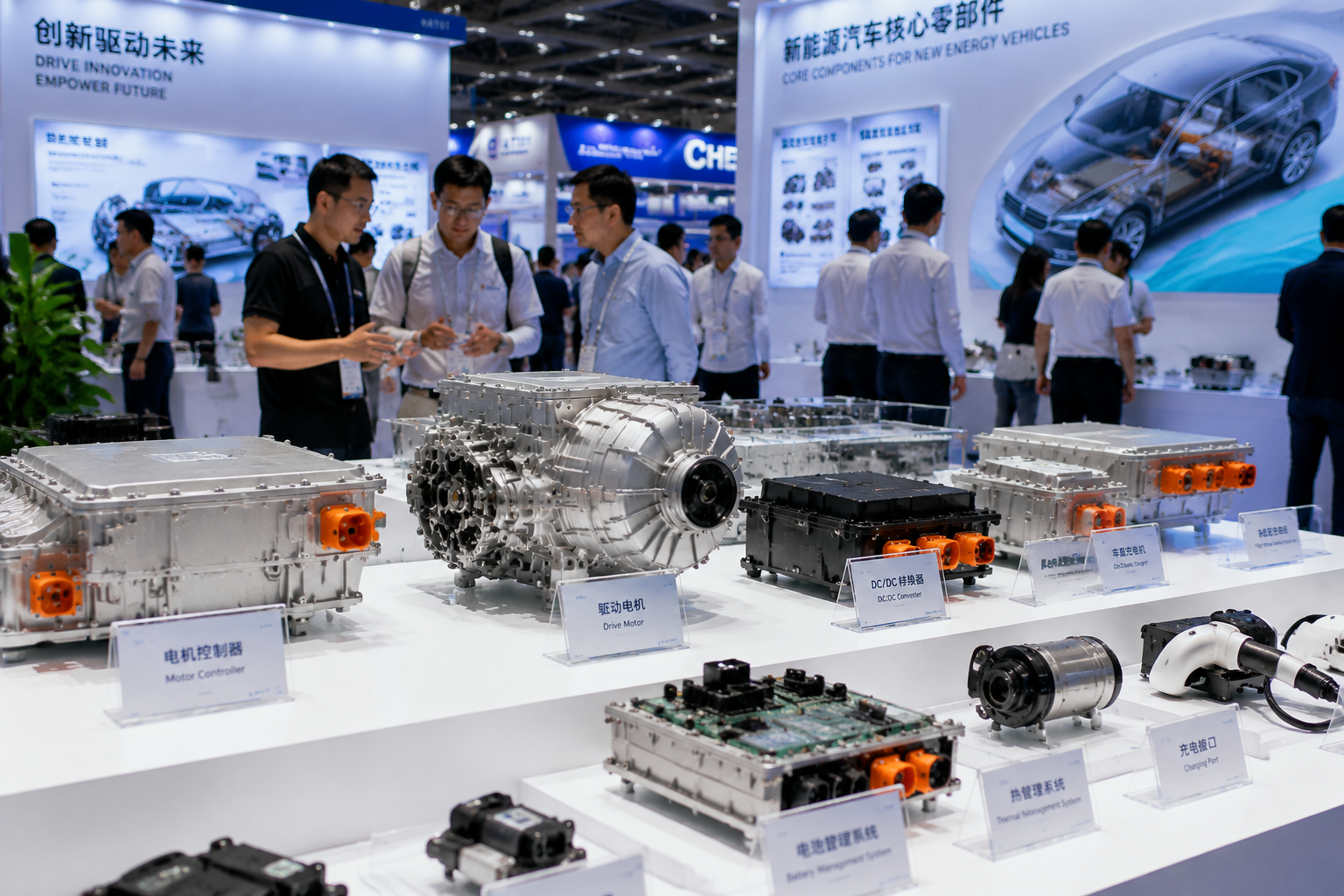
Finding a reliable electric vehicle components exhibition in Shanghai can be the difference between securing factory-direct pricing and wasting months chasing unverified suppliers. At APES Shanghai 2026, taking place July 2026 at the National Exhibition and Convention Center, global buyers gain direct access to over 1,200 Chinese manufacturers specialized in NEV powertrain, battery, chassis, and electronic systems. Li Cheng, international exhibition marketing strategist with a decade of experience in automotive trade shows, explains that the event’s unique industrial cluster approach means visitors walk into halls organized by manufacturing regions, such as Zhejiang for actuators, Jiangsu for lighting, and Hebei for filters, not random booth assortments. That structure transforms a trade show visit into a systematic sourcing mission.
Why a Shanghai EV Components Exhibition Delivers Different Sourcing Value
The core advantage of a dedicated EV components exhibition in Shanghai lies in the concentration of China’s manufacturing expertise under one roof. Unlike generic auto parts shows that scatter internal combustion engine components alongside a handful of EV parts, APES 2026 dedicates entire halls to new energy vehicle supply chains. This means a procurement manager sourcing high-voltage connectors does not wade through exhaust system suppliers but walks a floor where every exhibitor already understands ISO 26262 functional safety and IATF 16949 quality management systems.
Industrial clusters drive a second layer of efficiency. We have observed that buyers who pre-map the geographic distribution of China’s EV component zones, Ruian for brake systems, Changzhou for lighting, Wenzhou for electronics, and Shiyan for commercial vehicle parts, can interview three times as many qualified suppliers in a single day compared with a random walk. The APES hall plan expressly groups exhibitors by these clusters, so a morning spent in the Zhejiang pavilion often produces actionable quotations before lunch.
Navigating the APES 2026 Exhibition Layout and Industry Clusters
Understanding the hall segmentation before arrival cuts wasted hours. The following table summarizes the major zones and the product categories buyers typically source there.
Cluster Region
Key EV Components On Offer
Typical Supplier Profile
Zhejiang (Taizhou, Wenzhou, Ruian)
Motor shafts, actuators, brake-by-wire modules, wiring harnesses
Mid-volume OEM/ODM with short lead times
Jiangsu (Changzhou, Nanjing)
LED headlamps, thermal management modules, charging guns
High-automation lines, full testing traceability
Hebei (Qinghe, Hejian)
Oil seals, air filters, rubber hoses, cabin filters
Cost-competitive, large batch capability
Hubei (Shiyan)
Heavy-duty truck EV conversion kits, e-axles, battery structural components
Electronics-intensive, strong in software integration
A practical tactic I recommend is to arrive with a printed bill of materials and walk the assigned cluster first. Instead of asking “do you make EV parts?”, which every booth will answer affirmatively, ask “can you show me your P-FMEA for the motor controller connector?” That question instantly separates engineering-driven manufacturers from trading companies.
Verifying Quality and Certifications of EV Parts Suppliers Onsite
The presence of an IATF 16949 certificate on a booth wall tells you the supplier passed an audit, but it does not tell you how the supplier treats a 500-piece trial order. I focus on three verifiable signs at the exhibition. First, ask to see a process capability study for a dimension critical to your assembly. A manufacturer who can produce a CPK report within minutes, even on a tablet, operates at a different transparency level than one who deflects. Second, examine a cutaway sample or production reject board. The way a supplier documents failures reveals whether their corrective action system is real or a binder exercise. Third, if possible, request a live video call with the factory floor during the booth meeting. I have seen buyers receive a walkthrough showing raw material traceability systems and ESD-protected assembly lines within ten minutes, an experience no catalog can replicate.
Documentation availability varies by region and component tier. Products classified as safety-critical, steering knuckles, brake calipers, high-voltage contactors, will almost always have PPAP Level 3 documentation ready. For less regulated commodities like interior trim clips, a supplier may only offer a dimensional report. Align your documentation expectations with component risk.
Booth Costs, Visa Logistics, and Practical Planning for APES 2026
Budgeting accurately prevents last-minute compromises. The table below shows typical participation cost ranges observed across recent APES editions. Actual pricing depends on location within the hall, early-bird registration, and package inclusions.
Participation Type
Cost Range (USD)
What It Covers
Shell scheme booth (9 sqm, standard fascia, carpet, one table, two chairs, lighting)
4,200 – 5,500
Basic build, fascia nameboard, daily cleaning
Raw space (minimum 36 sqm)
360 per sqm
Empty floor space; exhibitor builds own stand
Buyer visitor registration
Free (pre-registration) or USD 30 onsite
Entry to all halls, buyer lounge access, show directory
Visa processing remains one of the few friction points buyers cannot fully control. The APES organizer issues a standardized invitation letter for business visa applications, but I advise beginning the process at least ten weeks before the event. Some consulates in Africa, the Middle East, and South Asia require additional documentation beyond the invitation letter, including confirmed hotel reservations and round-trip flight itineraries. Factor that lead time into your planning.
How to Register as a Buyer or Exhibitor for APES 2026
Registration splits into three straightforward pathways. International buyers complete an online form at the official APES portal, selecting their product categories of interest. The system issues a QR code that grants fast-track entry and pre-loads your sourcing preferences into the buyer matchmaking platform. I suggest uploading a brief company profile and sourcing checklist at registration, the matchmaking algorithm then suggests exhibitors aligned with your needs before you even board the plane.
Exhibitor applications follow a more consultative process. Because APES assigns booth locations by product category and cluster, the sales team first evaluates your product scope and recommends the optimal hall and neighboring zones. Contact the APES team directly with your proposed exhibit and any required utilities—compressed air, 380 V power, water drainage for live demonstrations—to receive a tailored quotation.
What Buyers Most Often Ask About Shanghai EV Components Exhibitions
Is an APES exhibition more targeted than a general auto parts show?
APES dedicates 40% of its floor plan to pure EV and NEV components, compared with roughly 15% at general automotive trade fairs. That concentration means a buyer sourcing a battery thermal management module does not lose time scanning unrelated product categories. The hall layout mirrors actual supply chains, so adjacent booths often form complementary sourcing combinations, a motor shaft supplier next to a winding services provider, for instance.
Can I really obtain factory-direct pricing at the exhibition?
Most exhibitors quote exhibition prices roughly 5-12% below their standard FOB offers, largely because they factor in the cost savings from meeting multiple qualified buyers in one trip and the competitive pressure of being in the same hall as their domestic rivals. The best practice is to request a firm quotation during the meeting, then send a follow-up email within 48 hours referencing the booth discussion to lock in the rate.
What about language and technical communication?
We have found that 70% of engineering and sales leads at booth level can hold a technical conversation in English. For deeper engineering discussions involving tolerance stacks or material specifications, many Chinese exhibitors bring a dedicated English-speaking applications engineer. As a backup, APES operates a free interpreter desk in each hall. Still, I recommend bringing your own bilingual inspection criteria and critical-to-quality drawings printed on A3; a picture of a go/no-go gauge often solves a discussion faster than any translator.
How do I follow up after the exhibition to avoid losing momentum?
Suppliers judge buyer seriousness by the speed and specificity of their follow-up. Within one week, send a concise email that references the booth conversation, attaches your RFQ with part numbers and annual volumes, and requests either a quotation or a formal NDA before technical data exchange. For assistance reconnecting with suppliers whose contacts you misplaced, share your exhibitor list with APES at apeschina@huamogroup.com, and the matchmaking team will forward your request.
For buyers serious about converting EV supply chain complexity into a competitive advantage, APES 2026 offers a direct path from factory floor to quality-approved component. Send your sourcing requirements and preferred supplier categories to apeschina@huamogroup.com or call +021-60280788, and the team will connect you with relevant exhibitors before the exhibition opens.
If you’re interested, check out these related articles: