EV Parts Sourcing Expo China How Factory-Direct Exhibitions Cut Procurement Cost and Lead Time
Industry news
2026-07-08
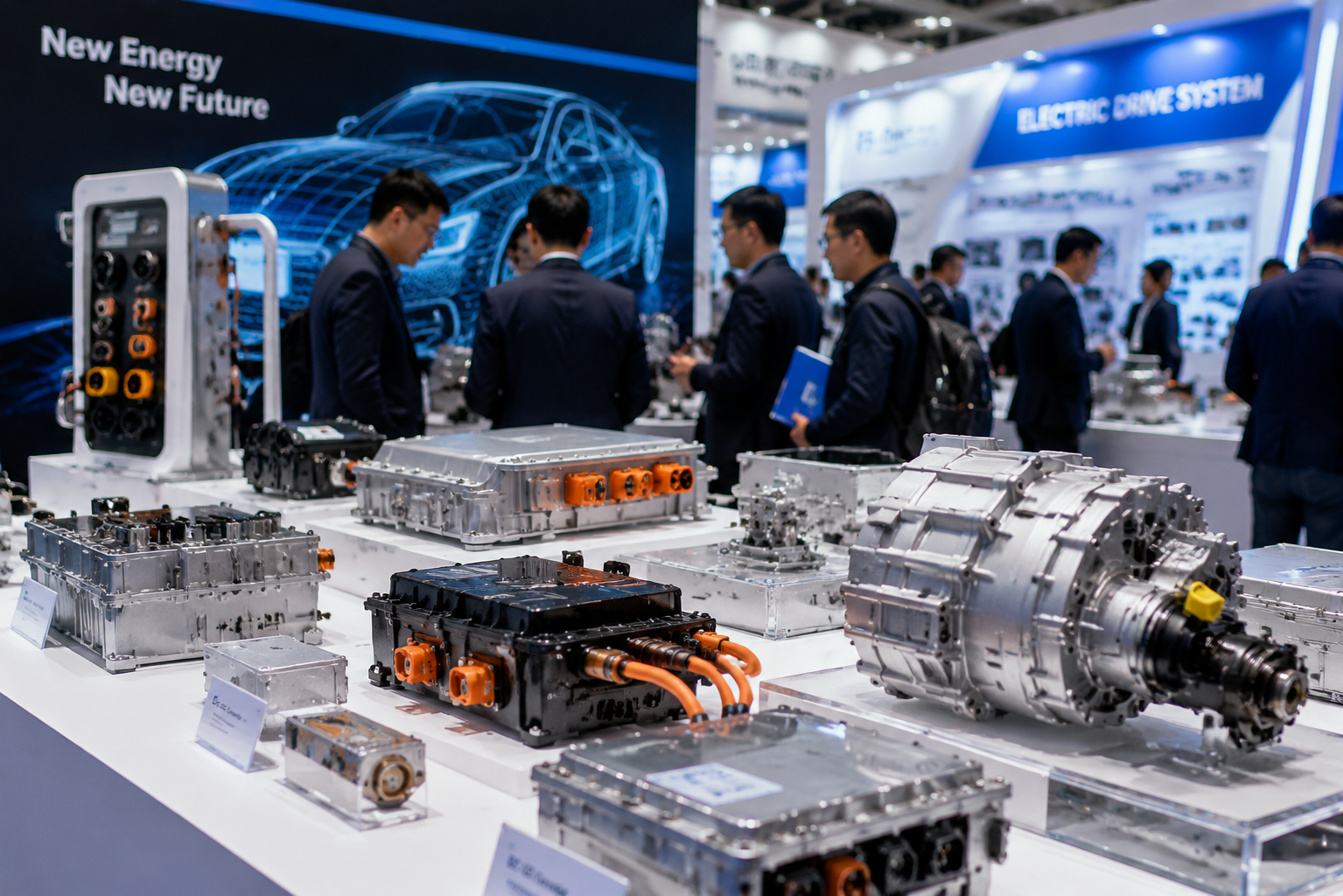
For procurement directors managing global supply chains, the challenge with electric vehicle components is not just finding a supplier but controlling the total cost of ownership. Published market data confirms over 60 percent of global NEV component production is tied to China’s manufacturing base. What market reports often miss is that the trade show floor itself is the most immediate lever for cost reduction. I have spent ten years organizing automotive trade exhibitions in China, and across thousands of buyer-exhibitor meetings I have seen one pattern repeat: the buyers who treat an expo as a sourcing trip, not a browsing trip, walk away with per-unit costs 10 to 20 percent below those quoted through intermediary channels. EV parts sourcing expos in China let you compress supplier evaluation from months to days, because you are standing in front of the factory’s engineering team with production samples on the table.
Booths at these events cluster manufacturers by industrial region. On one aisle you find a dozen Yuhuan chassis producers; three halls over, Ruian brake system specialists and Changzhou lighting manufacturers show their latest tooling. This geographic density is not accidental. Chinese auto parts industrial clusters have evolved over decades, each city or county specializing in one component category. Yuhuan alone accounts for roughly one-third of China’s chassis parts export volume. When you schedule meetings back-to-back across these regional clusters, you are effectively building a supply chain map in two or three days, something that would take months of travel and sample shipping to replicate outside the exhibition environment.
The structural advantage of factory-direct sourcing at a specialized expo comes down to three points: transparent origin verification, engineering-level technical discussion, and benchmarked pricing. At a general trade fair, the person staffing a booth may be a regional distributor who cannot answer questions about material grade changes or IATF 16949 audit schedules. At an EV parts sourcing expo in Shanghai or a major manufacturing city, the booth is typically staffed by the export manager and at least one application engineer from the plant. This means a procurement engineer can ask, for instance, whether a high-voltage wiring harness uses silver-plated or tin-plated terminals and get an answer backed by test data within minutes. For NEV programs where thermal management and electrical safety requirements shift frequently, that speed of technical confirmation prevents delays that later turn into six-figure requalification costs.
Pricing at factory-direct exhibitions works differently from B2B platforms. When a manufacturer quotes through an online marketplace, the price typically builds in a margin for the platform commission and sometimes for a trading company intermediary that manages the listing. When that same manufacturer brings samples and a quotation sheet to an exhibition booth, the price reflects factory-gate economics because the negotiation is face-to-face with the decision-maker who controls the production line. In practice, a brake caliper quote received at a Ruian supplier’s booth commonly runs 8 to 15 percent below the same item’s FOB price on a digital sourcing platform, because no third-party commission is embedded.
New product launch cycles at Chinese EV parts expos are also faster than many international buyers expect. A Tier-1 or Tier-2 manufacturer that completes a new electric motor shaft design in April will often debut the sample at a July or August exhibition. For a European or US buyer, this means the exhibition becomes the first touchpoint for a component that will not appear in catalogs or platform listings for another quarter. Early engagement at the show can open a supplier’s production allocation before competing buyers place orders, which is operationally significant when global capacity for certain NEV-specific parts remains tight.
Mid-article insight: If your sourcing plan includes components like battery structural housings or integrated thermal management modules that are subject to rapid design iteration, obtaining a technical data package directly from the booth engineer gives you a four-to-six-month lead over competitors waiting for updated platform listings. The production-capacity conversation happens in the aisle, not through a request-for-quote form.
Exhibitions are also where Chinese manufacturers demonstrate their quality system credentials in a way that is instantly verifiable. It is routine for an auto electronics exhibitor to display IATF 16949 certificates, ISO 14001 environmental management documentation, and test reports from recognized laboratories on the booth walls or in printed binders. If you are sourcing NEV sensors or control modules, ask to see the PPAP (Production Part Approval Process) documentation for a part number currently in production, not a golden sample. A manufacturer that can produce a full PPAP package on the spot has already passed the audit readiness check that matters most. Many professional buyers walk the show floor with a simple checklist: factory location, export license, IATF certificate visible, PPAP availability, and minimum order quantity flexibility. A two-day visit can screen 20 to 30 potential suppliers against these criteria, a screening density that no online sourcing tool replicates.
The structure of a specialized EV parts sourcing expo also supports comparative technical evaluation more efficiently than other formats. Below is a typical cross-section of product zones at a major Shanghai-based event.
Product Zone
Representative Components
Typical Exhibitor Profile
Powertrain & EV Drivetrain
Motor shafts, rotors, reduction gears, housing castings
Tier-2 precision machining factories from Zhejiang and Jiangsu
Forging and stamping factories from Yuhuan and Ruian clusters
Electronics & ADAS
Radar brackets, camera mounts, sensor cleaning systems
Precision plastic and die-casting manufacturers with clean-room assembly
Walking a buyer through these zones sequentially creates a natural procurement logic: from the core drivetrain outward to chassis, then thermal, then electronics. Most professional buyers I have supported at these events plan their route by zone priority, not by booth number. This means before the exhibition opens, a procurement team should map their bill of materials against the zone layout and book meetings with shortlisted exhibitors in advance. The floor layout of an exhibition like APES is intentionally designed to mirror a vehicle’s system architecture, so a buyer can move from engine-related components at one end to body electronics at the other without crisscrossing halls inefficiently.
A practical question many first-time attendees ask is how much a booth costs, but from a buyer’s perspective the relevant metric is not the exhibitor’s spend, it is your own cost per qualified supplier contact. A professional visitor registration typically costs nothing or a nominal fee. Your real investment is travel, accommodation, and the time of your engineering and procurement staff. If a three-day visit screens 25 suppliers and identifies three qualified partners, the cost per qualified contact is often under USD 500, a fraction of what a scouting trip to individual factories across multiple Chinese provinces would entail. Compare this to flying to Zhejiang, then to Hebei, then to Hubei over two weeks; the exhibition compresses geography and time into one venue.
The buyer profile at a major Chinese EV parts expo is another underappreciated advantage. These events draw purchasing delegations from over 100 countries, including concentrated groups from the Middle East, Southeast Asia, South Asia, and Africa. For a manufacturer or trading company, this means the exhibition itself becomes a market intelligence opportunity. Talking to a procurement manager from a Vietnamese EV assembler in the aisle tells you what specifications that market demands and what price points are competitive. These conversations are unstructured, spontaneous, and commercially valuable. They happen because 35,000 buyers in one building create a density of industry interaction that no other channel provides.
When buyers ask me whether they can get factory pricing at an exhibition, the answer depends on preparation. Factory pricing is available, but it is negotiated, not posted. A buyer who arrives with annual volume projections or a technical specification for a specific part number can discuss pricing and tooling cost amortization with the factory’s export director in concrete terms. A buyer who arrives without specifications gets general price ranges. In that sense, the exhibition floor is a level playing field: the suppliers bring production samples and cost models; the buyers who bring demand clarity get the best commercial terms.
Concerns about quality are common, and the exhibition environment addresses them directly. Chinese manufacturers serving export markets understand that a trade show is an audit. Booth displays often include cutaway samples, material certificates, and salt-spray test results for coated components. An OEM purchasing engineer can examine a control arm’s weld consistency, ask about the forging line’s cycle time, and request the material traceability report on the spot. These physical verifications cannot be replaced by a digital catalog photograph, no matter how high-resolution.
The newer generation of NEV-specific parts, including high-voltage connectors, battery tray structures, and e-axle housings, is heavily represented at China’s EV-focused expos. Many of these components require production capabilities that go beyond traditional internal combustion engine parts, particularly in aluminum extrusion, friction stir welding, and electrical insulation testing. Exhibitions concentrate these specialized manufacturers in one location, which is why an increasing number of European and North American NEV startups send purchasing teams specifically to Shanghai-based EV parts sourcing events.
From a supply chain resilience perspective, the exhibition also serves as a risk-management trip. A buyer can verify whether a supplier’s factory is genuinely located in the claimed industrial cluster, whether the production scale matches the capability presentation, and whether the export team has experience with the buyer’s regional homologation requirements. These verification steps are difficult to perform remotely and become straightforward when you can look at a factory’s export shipping records in person.
Post-exhibition follow-up is where many buyers lose the advantage they gained on the show floor. The contacts collected at the exhibition should enter a structured follow-up sequence within 72 hours: confirm the meeting summary, request the formal quotation for discussed part numbers, and schedule a factory visit or video audit if the supplier passed the preliminary screening. Suppliers who exhibited at the show expect this rapid follow-up; they have allocated capacity and prepared documentation specifically for post-show engagement. Buyers who delay lose allocation priority because other procurement teams are moving through the same supplier lists in parallel.
For international buyers attending an EV parts sourcing expo in China, practical considerations include visa arrangements, interpreter services, and booth appointment scheduling. Most major exhibitions provide online buyer pre-registration and hotel booking partnerships. Interpreters with technical automotive vocabulary can be arranged through the exhibition organizer or local service providers; Mandarin-only booth staff are increasingly rare at export-oriented shows, but a technical interpreter still adds value when discussing complex specifications like dielectric withstand voltage or insulation resistance values for high-voltage components.
Common Questions From International Buyers Evaluating Chinese EV Parts Expos
What makes a dedicated EV parts expo different from a general automotive aftermarket show? A dedicated EV parts sourcing event concentrates exhibitors around high-voltage electrical systems, battery structural components, e-motor parts, and thermal management products, whereas a general aftermarket show distributes attention across traditional engine parts, accessories, and repair tools. For a buyer whose bill of materials is 70 percent or more NEV-specific, the dedicated show reduces the time spent filtering out irrelevant booths by at least half. The exhibitor qualification standards are also different; many dedicated EV parts shows require exhibitors to demonstrate series production experience with NEV components, not just prototype capability.
How do I verify supplier quality without visiting the factory? Exhibition booths provide a compressed audit environment. Ask to see the IATF 16949 certificate with the certificate number visible, request a production part sample with its associated dimensional inspection report, and confirm whether the supplier maintains a REACH and RoHS compliance documentation package for the components in scope. If these three items are available and well-organized at the booth, the supplier’s quality management maturity is generally in line with export requirements. Add a check for ISO 14001 if your program has environmental compliance mandates.
Is there a best time during the show for technical discussions? The first morning of the exhibition is often crowded with ceremonial activities and general networking. For detailed technical discussions, the afternoon of Day 1 and the morning of Day 2 are ideal because booth traffic moderates and the technical staff, who typically travel from the factory and stay near the venue, are at their most accessible. Day 3 is sometimes quieter, which can be useful for follow-up meetings with the most promising suppliers identified earlier.
Are NEV parts from Chinese manufacturers meeting OEM durability standards? In our experience supporting buyer-supplier introductions at these expos, an increasing number of Chinese NEV component manufacturers are already Tier-2 or Tier-1 suppliers to domestic EV brands that export vehicles to Europe and Southeast Asia. The durability testing regimes these suppliers undergo, including thermal cycling, vibration endurance, and salt spray corrosion testing, align with common OEM standards. The key is to ask for the test report for the specific part number you are sourcing, not a general capability statement, and to confirm whether the testing was performed at a laboratory accredited to ISO/IEC 17025.
Can I place a trial order directly at the exhibition? Most exhibitors are prepared to discuss trial order quantities and lead times during the show. A typical trial order for a mechanical component like a forged knuckle or a die-cast housing may range from 100 to 500 pieces, with tooling costs quoted separately if the part requires custom tooling. For standard catalog parts, factory stock availability can sometimes allow shipment within two weeks. Confirm the payment terms and Incoterms during the booth meeting; many manufacturers accept a 30 percent deposit with the balance before shipment for trial orders. If your program requires a specific delivery schedule, share this timeline at the booth so the supplier can confirm production slot availability before you leave. Send your requirements to apeschina@huamogroup.com or call +021-60280788 to begin pre-registration for the next edition.
If you’re interested, check out these related articles: