How to Find Reliable Air Filter Suppliers at China Expos
Industry news
2026-07-04
Sourcing air filter suppliers at a China expo is not about collecting as many brochures as possible. Procurement managers and importers get a rare window on the trade show floor: a single day to evaluate manufacturing capability, filter media quality, and export readiness face‑to‑face. But that opportunity only converts into a dependable supply chain when you walk into each booth with a structured qualification routine. Most sourcing guides stop at listing exhibition names and offering generic networking tips. In practice, what separates a multi‑year partnership from a costly quality dispute is how you verify technical claims during a 15‑minute booth conversation. This article draws on over a decade of B2B automotive exhibition marketing experience to give you the exact checks that move a promising catalog entry into a vetted supplier.
Pre‑Screening Suppliers Before the Show
You cannot assess 300 exhibitors in three days. Pre‑screening turns a long walk into a short list of qualified candidates. Start with the official exhibitor catalogue published by the event organizer. In the automotive filter segment, look beyond the generic “auto parts” label and focus on booths that specify product categories such as engine air filters, cabin filters, oil filters, and heavy‑duty filtration. A supplier that lists multiple filter types under a single booth often indicates an in‑house production line rather than a trading company buying on the spot.
Pay particular attention to the company profile details. Genuine manufacturers from China’s filter production clusters, like Qinghe in Hebei Province or Wenzhou in Zhejiang, will reference their OEM or ODM experience, annual capacity, and export markets. If the profile only mentions trade capabilities without naming a factory address or core process, that booth deserves extra scrutiny before you commit time to it. In my experience organizing global buyer‑supplier matching at large‑scale automotive trade events, the most productive meetings happen when buyers cross‑reference the exhibitor list against their target industrial cluster and arrive with a note on the supplier’s known OEM relationships.
What to Verify at the Booth
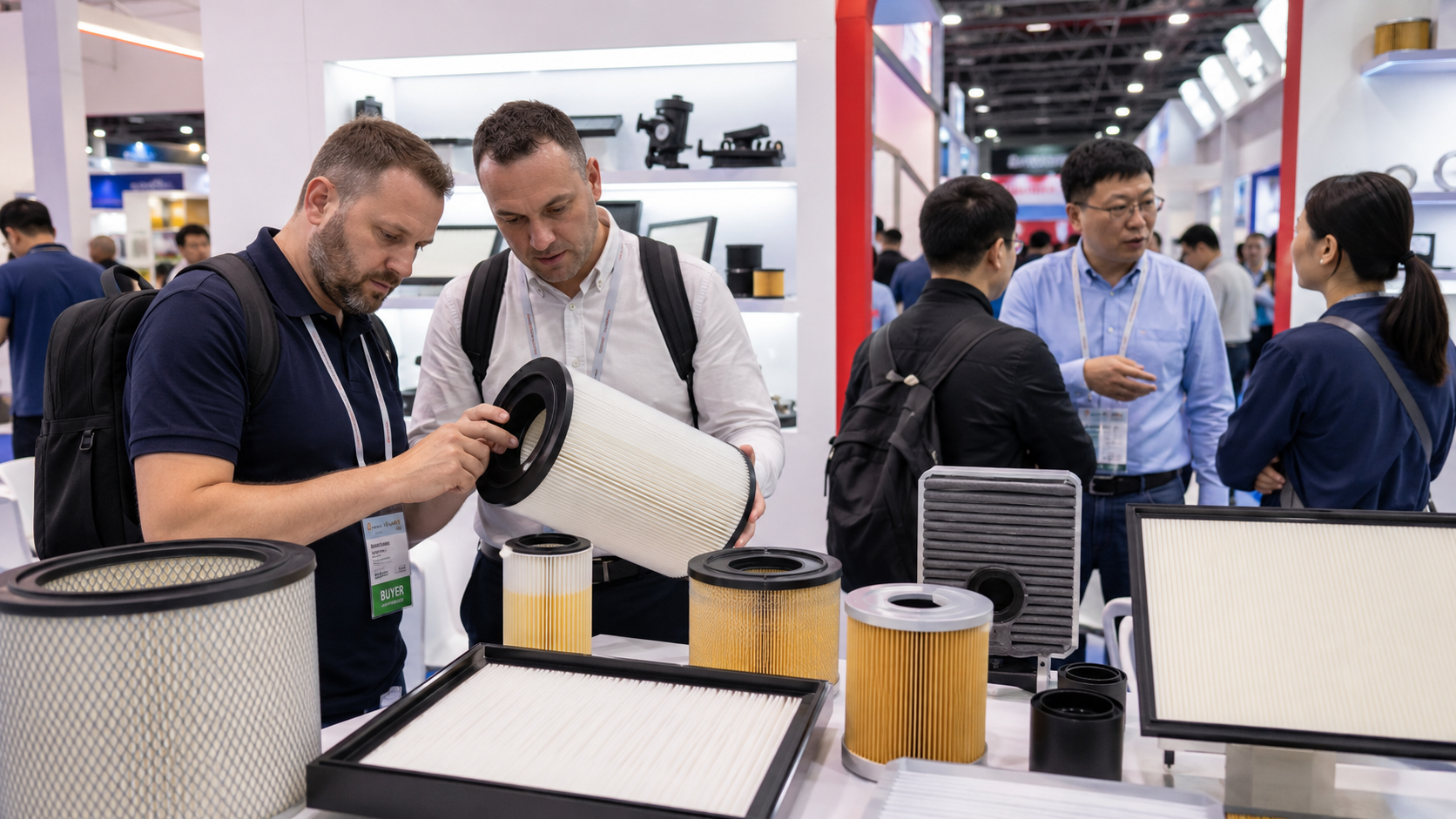
Once you reach the booth, the first 60 seconds should confirm whether the catalog matches reality. Inspect the display samples for detail quality. On an air filter, check the pleat count, the uniformity of the pleat spacing, and the glue bead consistency along the seal—inconsistent adhesive lines or uneven pleat height often reveal irregular production speed or less controlled curing processes. Run your finger along the seal edge; it should feel even and firmly bonded. Ask the booth representative to open a unit so you can see the filter media. Quality media from a reputable supplier will not feel brittle or shed fibres when lightly rubbed between your fingers.
Then move to a few specific process questions. Inquire what type of filter paper they use—cellulose, semi‑synthetic, or fully synthetic—and where it is sourced. A supplier that can name the paper grade and the mill without hesitation typically operates closer to the raw material specification than one that says “good quality imported paper”. Also ask about their dust holding capacity and filtration efficiency testing protocol. A factory that performs ISO 5011 or SAE J726 tests in‑house and keeps records per production batch is fundamentally a different partner from one that only relies on occasional third‑party checks.
If your program involves high‑mileage applications, confirm the supplier’s approach to humidity resistance and burst pressure compliance. A well‑equipped booth will have test reports on hand or accessible via tablet. The moment a supplier is willing to walk you through their specific test methodology, you have moved beyond a brochure exchange.
Reading Certifications and Test Data
Certifications can either anchor trust or mislead if you only look at the wall display. IATF 16949 remains the most demanding quality management standard specific to automotive production. When a supplier carries that certification, ask which exact manufacturing site is covered. Some trading companies display a group‑level certificate that does not extend to the filter line they are offering. Request the certificate number and verify the scope covers filtration products. ISO 9001 is a baseline, but for engine‑critical components like air filters, ISO 9001 alone does not guarantee the process control needed for consistent filter efficiency.
Beyond the quality management stamp, ask to see the product‑specific test protocols. A reliable air filter producer will be able to share the standard filtration efficiency curve across different particle sizes, not just the single‑point efficiency at a nominal micron rating. In practical terms, a statement like “99% efficiency at 10 microns” means little without the corresponding fractional efficiency data and the test dust specification, whether ISO 12103‑1 A2 fine dust or a coarser grade. When the supplier provides a data sheet with that level of detail, you can benchmark it against the filtration requirements of your target engine platform.
Quick Check
What to Ask
Red Flag Indicator
Media sourcing
Paper grade and mill name
Cannot name the supplier
In‑house testing
ISO 5011 / SAE J726 protocol
No batch records available
IATF 16949 scope
Site‑specific certificate number
Only a group certificate, filter line not in scope
Dust holding capacity
Grams at terminal pressure drop
Only a vague “high capacity” claim
Export documentation
Past shipment compliance file
No sample of previous export documents
Navigating MOQs, Pricing, and Export Terms
The commercial side often makes or breaks a sourcing deal from China, even when the product sample passes every technical check. A common mistake I see at exhibitions is buyers focusing on unit price before clarifying the minimum order quantity. For custom‑branded air filters with private label packaging, MOQs typically range from 500 to 2,000 units per SKU depending on the complexity of the printing and box die‑cut. For neutral‑packed stock products, MOQs can drop to 200‑500 units. Ask whether the MOQ applies per order or per SKU; this distinction alone saves thousands in overstock.
When pricing is discussed, break the quotation down into ex‑works, FOB, and CIF components. Many filter suppliers from Qinghe or Ruian quote ex‑works initially, which excludes inland transport and port handling. An FOB quote lets you compare suppliers on a like‑for‑like basis. If your shipment volume exceeds one 20‑foot container, ask about consolidation options across different filter types—often a single supplier can combine cabin, engine, and oil filters into one container to reduce per‑unit freight.
Payment terms for first orders commonly start at 30 % T/T in advance with 70 % before shipment or against a copy of documents. Suppliers with a strong export track record may accept L/C at sight after a couple of successful transactions. Use the booth conversation to gauge their export documentation capability: ask if they have previously shipped to your region and whether they can provide a sample set of export documents for review. A supplier who willingly shows a redacted past bill of lading and packing list is demonstrating operational transparency that a price list alone cannot offer.
After the Expo: Turning a Sample into a Supplier
The real sourcing decision almost never happens inside the exhibition hall. Your last day at the show should secure a clear follow‑through sequence. Collect the booth contact’s WeChat and email, and within 48 hours of leaving the venue, send a structured request that includes your filter specifications, target annual quantity, and a request for a physical pre‑production sample with test data. This filters out suppliers who are only active during the show and those truly interested in an ongoing partnership.
Once you receive the sample, route it to your quality team or an independent lab for efficiency and burst tests against the supplier’s submitted data. If the initial sample passes and commercial terms are within range, schedule a factory audit. The most valuable trade show conversations with filter suppliers in China lead to an on‑site visit where you can verify the production line speed, material inventory, and quality station procedures that no booth display can fully replicate. A factory that accepts a three‑day notice audit without reshaping its schedule is already a step closer to becoming a trusted partner.
If you are planning your next sourcing trip and want to meet pre‑qualified air filter manufacturers from the key production clusters under one roof, APES Auto Parts Expo Shanghai structures its exhibitor selection around verified manufacturing capability rather than just booth sales. Send your filter specifications, target volume, and any certification requirements to apeschina@huamogroup.com or call +021‑60280788, and our supplier matching team will connect you with exhibitors ready to discuss technical and commercial alignment.
Common Questions About Sourcing Air Filters at Chinese Expos
How do I know if a booth represents a real manufacturer or a trading company?
The fastest way is to ask for the factory address, photos of the production floor, and the specific equipment list. A manufacturer can immediately show you their pleating machine brand, curing oven specifications, and filter paper roll inventory. A trading company will usually redirect the conversation to product catalogues and price advantages. Request a live video walk‑through of the shop floor during your booth visit; most genuine manufacturers accommodate this within a few minutes while trading companies invent reasons to delay. Over the years, I have seen buyers skip this step and later discover they were paying a 15‑20 % markup for a filter made by a factory they could have visited directly.
What is the typical MOQ for air filters from China?
For stock products in neutral packaging, minimum order quantities usually sit between 200 and 500 pieces per model. When private branding with custom boxes and labels is required, MOQs commonly move to 1,000‑2,000 units per SKU, largely because of printing plate and box die‑cut setup costs. It is worth asking whether the supplier can consolidate several filter types into one container to reach the order volume without holding high stock on a single part number. If your initial needs are below 200 pieces, focus on suppliers that already keep inventory for fast‑moving applications; their willingness to break a pallet signals flexibility you can build on.
Can I get filters customized with my own brand at the show?
Yes, most manufacturers at automotive trade exhibitions offer private label or OEM branding. At the booth, discuss not just the logo print but also the packaging design, barcode format, and any required certification marks for your target market, such as E‑mark for Europe. Bring a mockup of your box artwork and ask for a pre‑production sample timeline. A supplier that can quote packaging development lead times on the spot, including mould or plate preparation, is demonstrating internal project management that generic “we can customize” statements lack.
What certifications should I look for besides IATF 16949?
For air filters, the product‑level testing certifications matter as much as the system certificate. Ask for ISO 5011 or SAE J726 test reports for engine air filters and, depending on the region, compliance data for cabin filter particle removal efficiency per ISO 16890. If your market requires REACH compliance for materials or emissions testing, confirm whether the supplier has experience preparing those documentation packages. A supplier that has exported to Europe or North America will usually keep a compliance file ready. Share your specific regulatory landscape with our team at apeschina@huamogroup.com, and we will direct you to exhibitors who are equipped to provide the necessary documentation.
If you’re interested, check out these related articles: