How to Source High Voltage Wiring Harness Suppliers in China
Industry news
2026-07-11
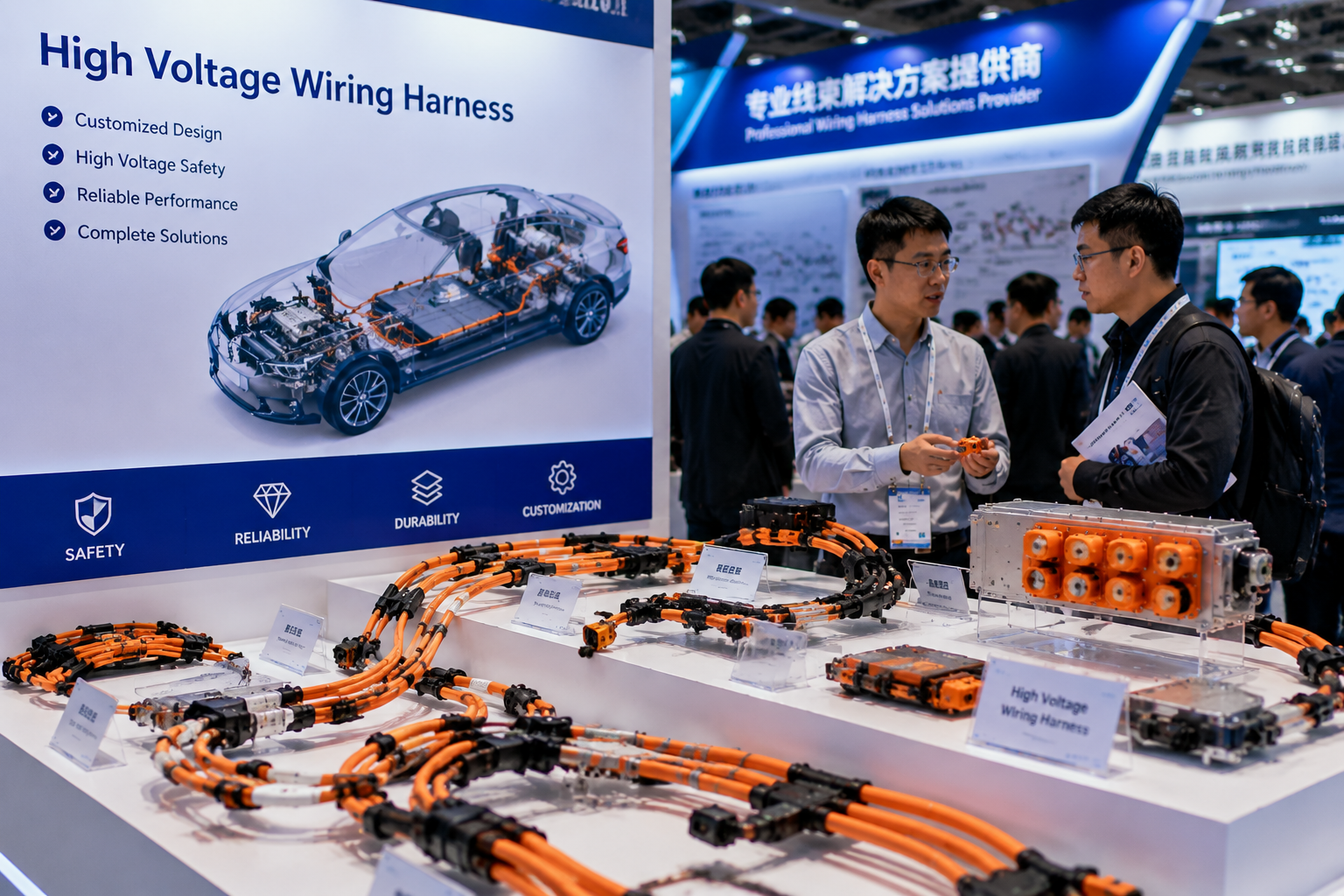
Finding a high voltage wiring harness supplier in China involves more than scrolling through online catalogs. Trade shows offer a direct line to factory-floor capabilities, allowing procurement teams to inspect samples, discuss custom specifications, and assess manufacturing competence face-to-face. Over a decade of connecting global buyers with Chinese automotive parts manufacturers has shown that exhibition-based sourcing consistently yields more reliable partnerships than digital vetting alone.
The Landscape for High Voltage Wiring Harness Suppliers in China
China’s high voltage wiring harness supply base has expanded rapidly alongside the electric vehicle market. Thousands of manufacturers now operate across multiple provinces, ranging from small workshops that serve the domestic aftermarket to medium-sized factories that supply OEM and Tier‑1 programs. Zhejiang, Jiangsu, and Guangdong are the dominant clusters, each with a distinct technical emphasis: Zhejiang for connector and harness assembly, Jiangsu for high-voltage cable and system integration, and Guangdong for precision components and testing. The sheer number of options makes supplier identification overwhelming, especially when an online search returns hundreds of undifferentiated profiles. An exhibition floor condenses that landscape into aisles where capability differences become visible within hours.
Why Trade Shows Beat Online Sourcing for Harness Supplier Evaluation
Online platforms give you a catalog. A trade show gives you the product, the engineer, and the testing bay in one visit. I’ve seen buyers walk away from a booth with a thermal cycling report that contradicts what the website claimed, and that single discrepancy saves months of back-and-forth. The physical presence of voltage withstand testers, insulation resistance meters, and crimp height gauges tells you whether the factory actually owns the quality tools or rents them for the audit photo.
Sourcing Channel
What You See
What You Miss
Online B2B platform
Stock photos, brochures, emailed certificates
Real-time test data, build quality of samples, engineer’s problem-solving approach
Trade show booth
Physical harness assemblies, live test demonstrations, direct conversation with QC staff
None — you can request on‑the‑spot design-for‑manufacturing feedback or a preliminary PPAP schedule
Buyers frequently report that the first in‑person discussion surfaces requirements the supplier never mentioned online. When a harness must handle 800 V, 200 A, and IP6K9K sealing, you cannot afford to discover a supplier’s ignorance of creepage distance rules after the purchase order is signed.
Key Industrial Clusters for EV Wiring Harness Production
Understanding where manufacturers cluster helps you self-select the suppliers you visit. Zhejiang (notably Ningbo, Taizhou, and Wenzhou) has a deep ecosystem of connector mold makers, terminal stampers, and harness assemblers; many started with low-voltage automotive wiring and migrated to high-voltage platforms. Jiangsu (Suzhou, Changzhou, Wuxi) concentrates on silicone‑insulated cable, high-flex cable for battery packs, and fully automated harness processing lines. Guangdong (Shenzhen, Dongguan) leads in miniaturized connector design and in‑house EMI simulation. At our exhibitions, regional pavilions gather 20–30 manufacturers from the same cluster, so you can benchmark quality and pricing across a district in a single afternoon.
If your high voltage harness involves complex shielding or IP6K9K sealing requirements, verifying a supplier’s in‑house testing lab at the exhibition can eliminate costly post‑delivery surprises. For a list of exhibiting manufacturers that offer in‑house design and validation, contact our buyer services team at apeschina@huamogroup.com.
A structured walk-through prevents the common mistake of collecting brochures without genuine intel. Focus on three phases: documentation, technical demonstration, and commercial fit.
What certifications should a harness supplier hold?
Minimum acceptable is IATF 16949. Ask to see the certificate on the spot and note the issuing body. I’ve encountered situations where the certificate copy omits the scope of registration, which should explicitly list “wiring harness” or “cable assembly.” For European programs, look for VDA 6.3 audit reports and knowledge of LV 214 connector standards.
How to verify a supplier’s manufacturing capability on site?
Walk the booth as if it were a mini production line. Count the in‑house test equipment: a HiPot tester, a temperature cycling chamber, a tensile test machine, and a cross‑section microscope for crimp analysis indicate the factory runs its own validation. A table covered only with finished harnesses rarely belongs to a manufacturer that owns die sets.
What questions reveal commercial reliability?
Ask the MOQ for a custom 6-cavity overmold. If the answer is immediate and accompanied by a tooling cost estimate, you are speaking with someone who controls mold design. Then ask about lead time for 1,000‑unit pilot orders and whether the factory carries commonly used connectors in stock (e.g., Amphenol, TE, or local equivalents). An honest answer often includes a conditional delivery window based on connector availability, which is normal and a sign of real production scheduling.
Evaluation Area
Key Questions
Certification
Show me the current IATF 16949 scope. Which OEMs have you shipped harnesses to in the last 12 months?
Technical capability
Do you have an in‑house HiPot tester rated for 5 kV DC? Can you perform thermal cycling from −40 °C to 125 °C?
Commercial terms
What is the MOQ for a custom overmolded connector? What is your standard payment structure for export?
Quality Standards Every High Voltage Harness Buyer Should Verify
Beyond IATF 16949, several product‑level standards govern high voltage wiring harnesses. LV 214 (often referenced by German OEMs) specifies mechanical, electrical, and environmental test methods for HV connectors. For charging harnesses, ISO 15118 and IEC 62196 define communication and physical interfaces. Connector sealing should meet ISO 20653 at the target IP rating (IP67 minimum, IP6K9K for exposed under‑body applications). A supplier that cannot immediately name the test duration and pass/fail criteria for a 2.5 kV AC dielectric withstand test is unlikely to have produced field‑validated parts. Even if a certificate scans correctly, ask for a recent test log from a production‑line sample; one data point on real serial production is worth ten on a golden sample.
From First Contact to Long‑Term Partnership After the Show
The real work begins after you leave the exhibition hall. Send a formal RFQ with 3D data within the first week; the suppliers who respond with a DFM report inside seven days are the ones running an engineering‑driven operation. Plan a factory visit or mandate a video inspection that covers the tooling room, the harness cutting/crimping station, and the final test area. Request partial PPAP submission (dimensional report, material certifications, and initial process capability study) before the pilot order. Over the years, the buyers who stay closest to the factory floor report the fewest field failures, so schedule a follow‑up meeting at the next exhibition cycle to review performance data face‑to‑face.
Sourcing a reliable high voltage wiring harness supplier from China does not have to be a gamble. The structured environment of a focused trade show like the APES Auto Parts Expo Shanghai puts you in direct contact with factory engineers and decision‑makers, dramatically shortening the qualification cycle. Bring your part drawings and target price. Send them to apeschina@huamogroup.com or call +021‑60280788, and our sourcing team will help identify exhibitors that match your technical and volume needs.
Questions Buyers Frequently Ask About China’s HV Harness Suppliers
Can a trade show really connect me with genuine factory‑direct harness manufacturers?
Yes, provided you qualify the booth. Manufacturers bring tooling samples, test reports with serial numbers, and engineers who can modify a 3D model on the spot. Trading companies often display a wider product range and defer technical questions. The difference becomes apparent in under five minutes of questioning about dielectric testing voltages or connector pitch dimensions.
What is the typical MOQ for custom EV high voltage wiring harnesses?
It varies. For a fully custom overmolded connector harness with multiple branch points, MOQs commonly start at 500–1,000 sets, mainly driven by mold investment and connector minimum order quantities. Suppliers will often amortize tooling cost across the first production order, making the initial batch the largest single expense.
How do I confirm a harness supplier’s IATF 16949 certification is valid?
Ask to see the original certificate during the exhibition and note the issuing body (e.g., TÜV, SGS, Bureau Veritas). Later, cross‑check the certification number on the IATF database. A valid certificate alone is not enough; the scope must include “wiring harness” or “cable assembly.” If the certification scope item appears vague, request the most recent surveillance audit report for the manufacturing site.
Is exhibition‑based sourcing more expensive than buying through online platforms?
Initially, it may cost the price of an air ticket, but the savings from accurate sample sign‑off, avoided re‑tooling, and faster PPAP often exceed the travel cost on the first shipment. Online platforms expose you to hundreds of suppliers; an exhibition lets you narrow to three qualified candidates in one trip. If your project demands specific LV 214 test data or field‑validated insulation resistance curves, share your requirements with our team; we can confirm which exhibitors hold that documentation before you travel.
If you’re interested, check out these related articles: